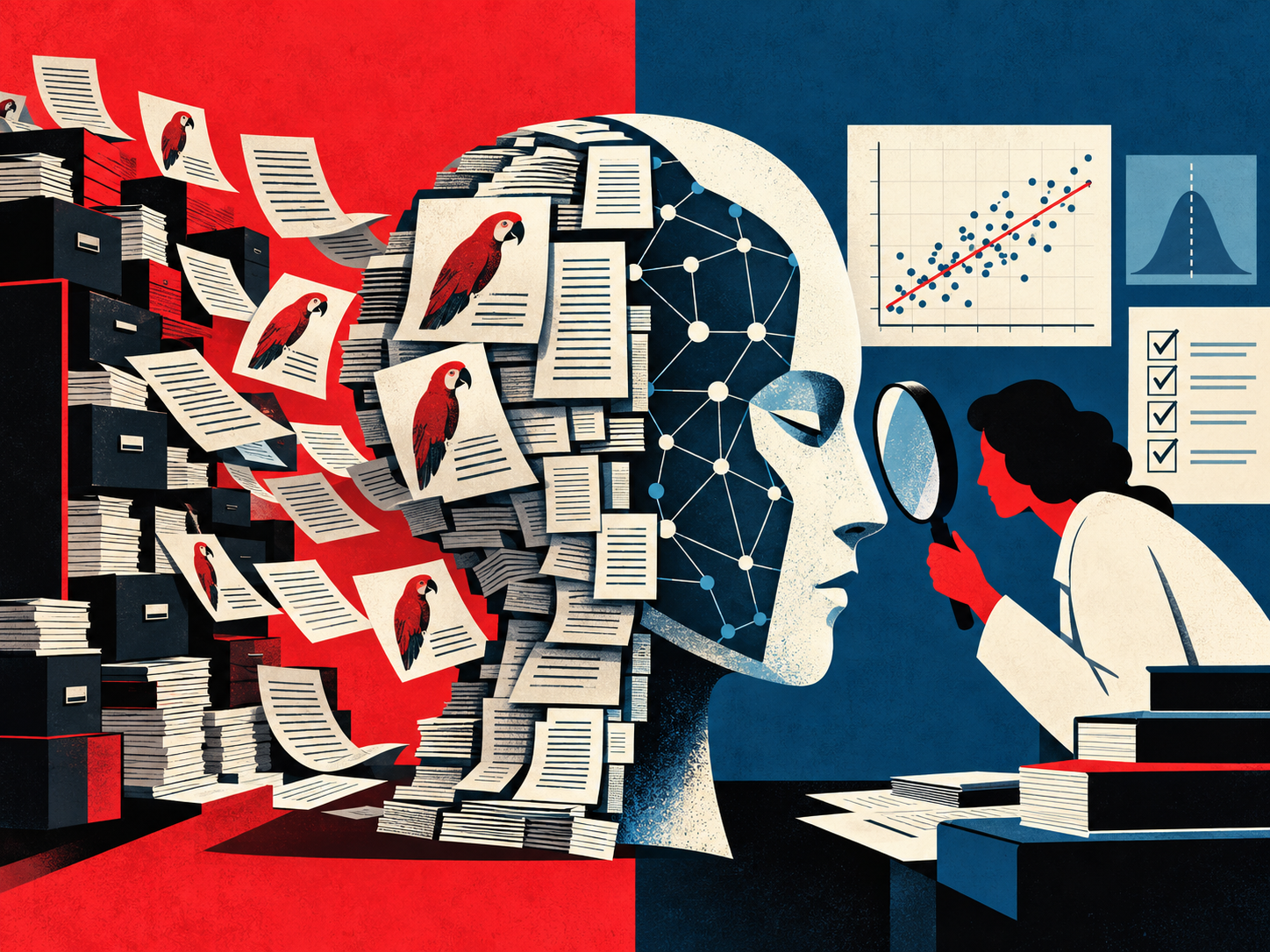
The enterprise is being hollowed out from the middle. Not by recession or mismanagement, but by a new class of cognitive technology that performs precisely the tasks on which middle-tier white-collar employment was built: summarising, scheduling, drafting, triaging, and routing decisions upward. The scale of dislocation now arriving in corporate balance sheets is without peacetime precedent.
Between 2023 and 2025, U.S. corporations announced over 1.17 million layoffs—54% more than 2024—while roughly 92% of Fortune 500 firms deployed generative AI in some capacity. The World Economic Forum projects a net gain of 78 million jobs by 2030, but only after 92 million existing roles are displaced and 170 million new ones created—a structural churn rate of 22% of current employment.
The question confronting senior leadership is no longer whether AI changes the workforce, but how to manage the transition from a headcount-driven operating model to one in which human capital and machine capital are jointly allocated, measured, and governed.
I. Who Goes: The Substitution Frontier
The automation frontier has advanced well beyond the factory floor. Goldman Sachs estimates that approximately 25% of all U.S. work tasks could be automated by current AI, with office and administrative support roles leading at 46% task exposure. The Wharton Penn Budget Model provides sharper granularity: office and administrative occupations face 75.5% task exposure, business and financial operations 68.4%, and computer and mathematical roles 62.6%.
The EDsmart analysis of 784 occupations confirms the concentration of risk: the top 50 most-exposed jobs average 86.3% automation exposure—nearly 2.9 times the national average—and 54% of those are office and administrative roles. Telemarketers top the list at 96.25%, followed by order clerks at 95.5% and insurance claims processors at 95.2%. Peak displacement is expected between 2027 and 2035.
A critical NBER working paper by Hampole, Papanikolaou, and Schmidt (2025) introduces task-level and firm-level measures of AI exposure across publicly traded firms from 2010 to 2023. Their core finding: AI exposure explains roughly 16% of the variation in occupational employment growth, with a one-standard-deviation increase in task-level AI exposure reducing demand for associated skills by about 2% over five years.
II. Who Stays: The Augmentation Premium
The substitution narrative, however, tells only half the story. A landmark study by Mäkelä and Stephany (2024), drawing on 12 million U.S. job vacancies from 2018 to 2023, finds that complementary effects of AI are 1.7 times larger than substitution effects. AI-focused roles are nearly twice as likely to require skills like resilience, agility, and analytical thinking compared to non-AI roles.
"The occupations most exposed to AI automation are actually outperforming the rest of the labour market in both job growth and real wage increases."
PwC Global AI Jobs Barometer 2025 · ~1 billion job advertisements analysed
PwC's 2025 Global AI Jobs Barometer delivers a striking counterpoint to declinist forecasts. Job growth in AI-exposed occupations rose from 1% pre-COVID to 1.7% post-2023, while all other jobs saw growth decline from 1.1% to 0.8%. AI-exposed industries saw productivity growth nearly quadruple, from 7% (2018–2022) to 27% (2018–2024).
The emerging premium worker is not the most technically skilled but the most cognitively flexible. The WEF identifies AI and big data as the fastest-rising competency demand, but this sits alongside creative thinking, resilience, flexibility, and lifelong learning. Oxford Internet Institute research confirms that practical AI expertise now outweighs formal qualifications: between 2018 and 2024, the share of AI job advertisements requiring a higher education degree fell from 36% to 31%.
III. The Hollowing of the Middle
The organisational structure of the twentieth-century corporation—a layered pyramid of junior analysts, middle managers, and senior executives—is being compressed into a barbell. A Gusto analysis of 8,500 small businesses finds that the ratio of individual contributors to a single manager has nearly doubled, from just over three in 2019 to nearly six today. This is not a gradual flattening but a structural rupture: companies are eliminating the coordination layers that once translated strategy into execution.
Amazon, Meta, Salesforce, and X have all cut middle-management roles in recent years. Tata Consultancy Services announced plans to eliminate approximately 12,000 jobs—about 2% of its workforce—primarily targeting middle and senior management. Fiverr cut 30% of its workforce explicitly to "reduce management layers and position it to pursue growth with an AI-native approach".
"Asmall cadre of strategic leaders at the top managing a vastly larger base of individual contributors and AI systems, with the traditional middle gutted."
Apoorv Agrawal, Partner, Altimeter Capital
IV. The Paradigm Shift in Human Capital Management
Moderna provides the clearest institutional signal that human capital management is fusing with technology governance. In late 2024, the biopharmaceutical company merged its HR and IT departments under a single executive, creating the role of Chief People and Digital Technology Officer. The company deployed more than 3,000 custom GPTs—including a "virtual HR agent" replacing certain junior-level HR tasks—while cutting approximately 10% of its technology workforce and simultaneously creating new hybrid roles.
This represents more than an operational merger. Moderna shifted from traditional workforce planning to work planning: a design-oriented approach that first determines what tasks need to be accomplished, then decides how they should be allocated between humans and machines. HR's remit is no longer hiring and retention; it is the continuous re-architecture of the human-machine interface.
V. Case Studies: The Early Movers
VI. The Unintended Consequences of Over-Automation
BCG's 2025 AI at Work survey reveals a pervasive adoption gap. While 77% of leaders and managers report using GenAI multiple times weekly, frontline adoption has plateaued at 51%—a "silicon ceiling" that threatens to widen the productivity gap within organisations. Only about one-quarter of frontline employees say they receive strong leadership support for AI adoption, yet that support is the single strongest predictor of usage, job satisfaction, and career optimism.
The most underappreciated risk of rapid AI adoption is not unemployment but cognitive decay. A 2025 MIT study found that individuals who consistently use LLMs for writing and decision-making exhibit reduced brain activity, diminished memory retention, and less original thinking. The EY 2025 Work Reimagined Survey—covering 15,000 employees across 29 countries—found that 64% report perceived increases in workload over the past year, yet only 5% are maximising AI to transform their work.
Perhaps the starkest quantitative warning concerns the workforce that remains after AI-driven restructuring. Seventy-four percent of employees who survive layoffs report a decline in their own productivity, while 77% witness an increase in operational errors. This "layoff survivor syndrome"—fuelled by anxiety and eroded institutional trust—may well eliminate the productivity gains that AI was deployed to achieve.
VII. Strategic Conclusions
The evidence points to three structural conclusions for executives and policymakers. First, the displacement-augmentation debate is a false binary. The same technology substitutes routine cognitive tasks while amplifying the premium on judgment, creativity, and relational intelligence. Complementary effects outweigh substitution effects by a factor of 1.7, but only for workers and organisations that actively invest in the augmentation pathway.
Second, the organisational unit of management is no longer the employee but the human-machine team. McKinsey's "25²" model, Moderna's HR-IT fusion, and BCG's AI Talent Horizon Framework all point toward the same conclusion: traditional HR functions—hiring, performance review, career pathing—must be reconceived as continuous human-AI integration management.
Third, the greatest risk is not technological unemployment but institutional hollowing. The Klarna case, the layoff survivor data, and the cognitive atrophy research all suggest that organisations pursuing AI as a pure substitution play are building a strategic debt that compounds over time. The firms that will dominate the next decade are not those that cut the most headcount, but those that most effectively redesign their human-machine allocation to concentrate human effort where it remains irreplaceable.
"The age of AI does not end human resource management. It elevates it from an administrative function to the central strategic discipline of the firm."
The Analyst · Human Capital Special Report · March 2026
SOURCES: World Economic Forum Future of Jobs Report 2025 · PwC Global AI Jobs Barometer 2025 · BCG AI at Work Survey 2025 · McKinsey Global Institute · NBER Working Papers (Hampole, Papanikolaou, Schmidt 2025) · Challenger Gray & Christmas Layoff Report 2025 · Wharton Penn Budget Model / Eloundou et al. 2024 · EY Work Reimagined Survey 2025 · Oxford Internet Institute 2024